
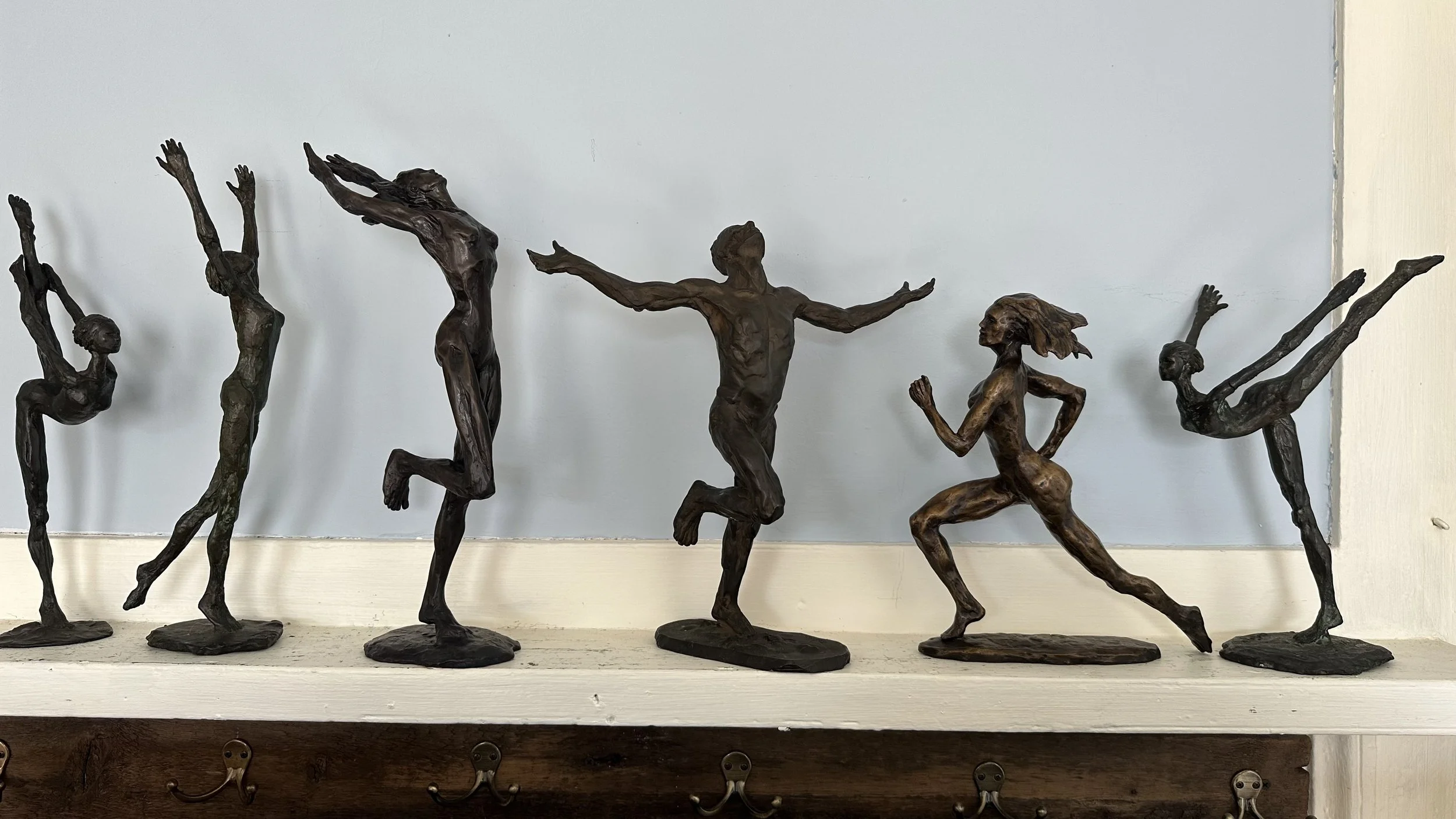
A selection of bronze statuettes sculpted by marathon trailblazer Bobbi Gibb.
Please scroll down to learn about Bobbi Gibb’s barrier-breaking 1966 Boston Marathon run.
(To view more photos of Gibb’s sculptures or explore the process of commissioning or ordering a bronze sculpture, please see our Buy Art page.)
Bobbi Gibb
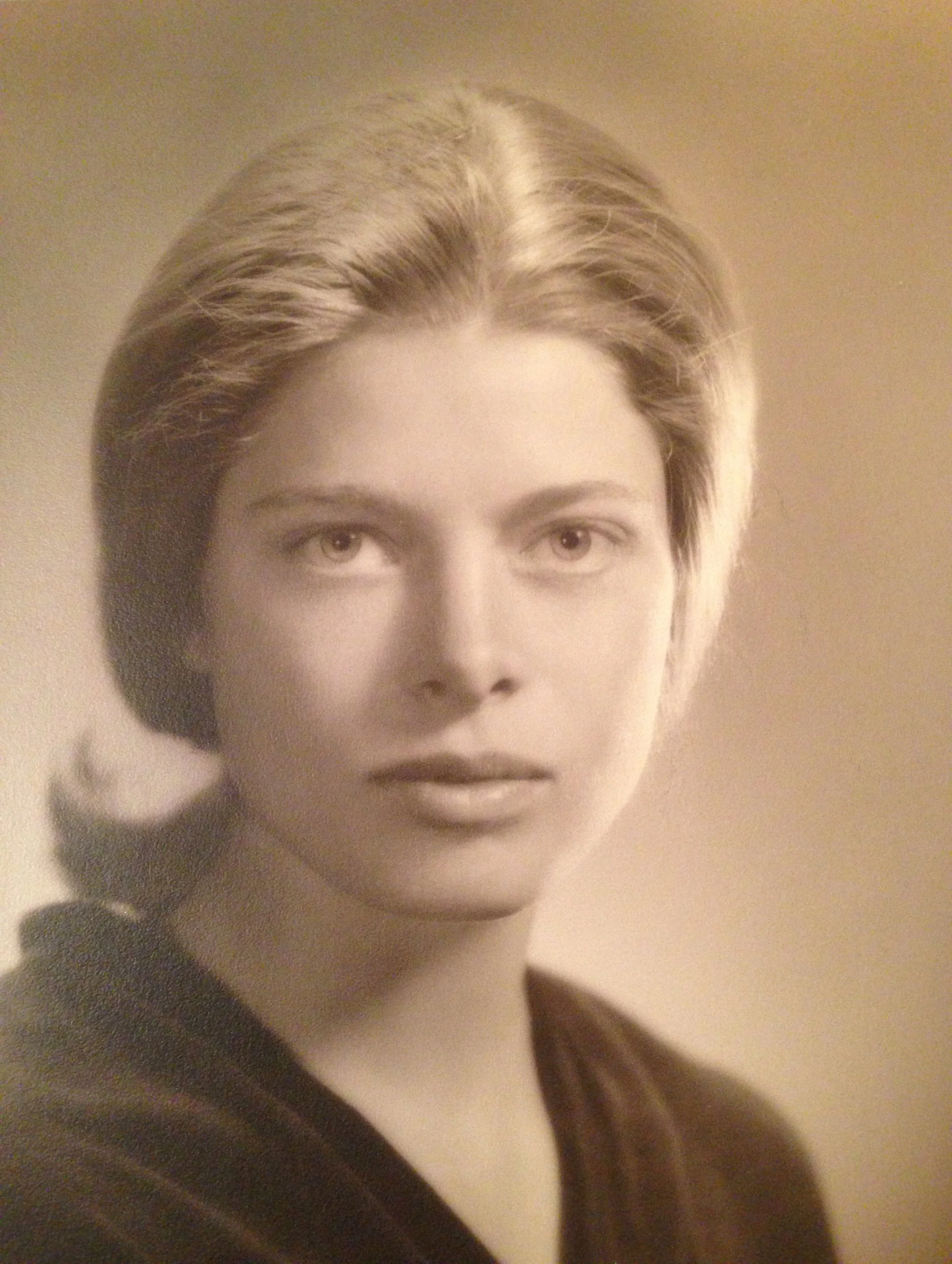
Bobbi Gibb at age 23, a few months before her breakthrough 1966 Boston Marathon.
This year, hundreds of thousands of women will run a marathon worldwide. In 1966, Bobbi Gibb was the only one. After adventures in the wilderness and the human world spanning 3,000 miles, her vision of how the world could be gave her the courage to overcome her fears and become the first woman to run the Boston Marathon.
At the start of this year's Boston Marathon, for the first time, a life-size bronze statue of Gibb watched over the tens of thousands of runners and spectators from the corner of Hayden Rowe St. and Main St. in Hopkinton. Gibb is both the subject and the sculptor of the statue. It is the first statue of a woman along the Boston Marathon course and depicts Gibb making history at age 23 by becoming the first woman to complete the Boston Marathon on April 19, 1966. It honors not only her achievement but also all who have followed in her footsteps.
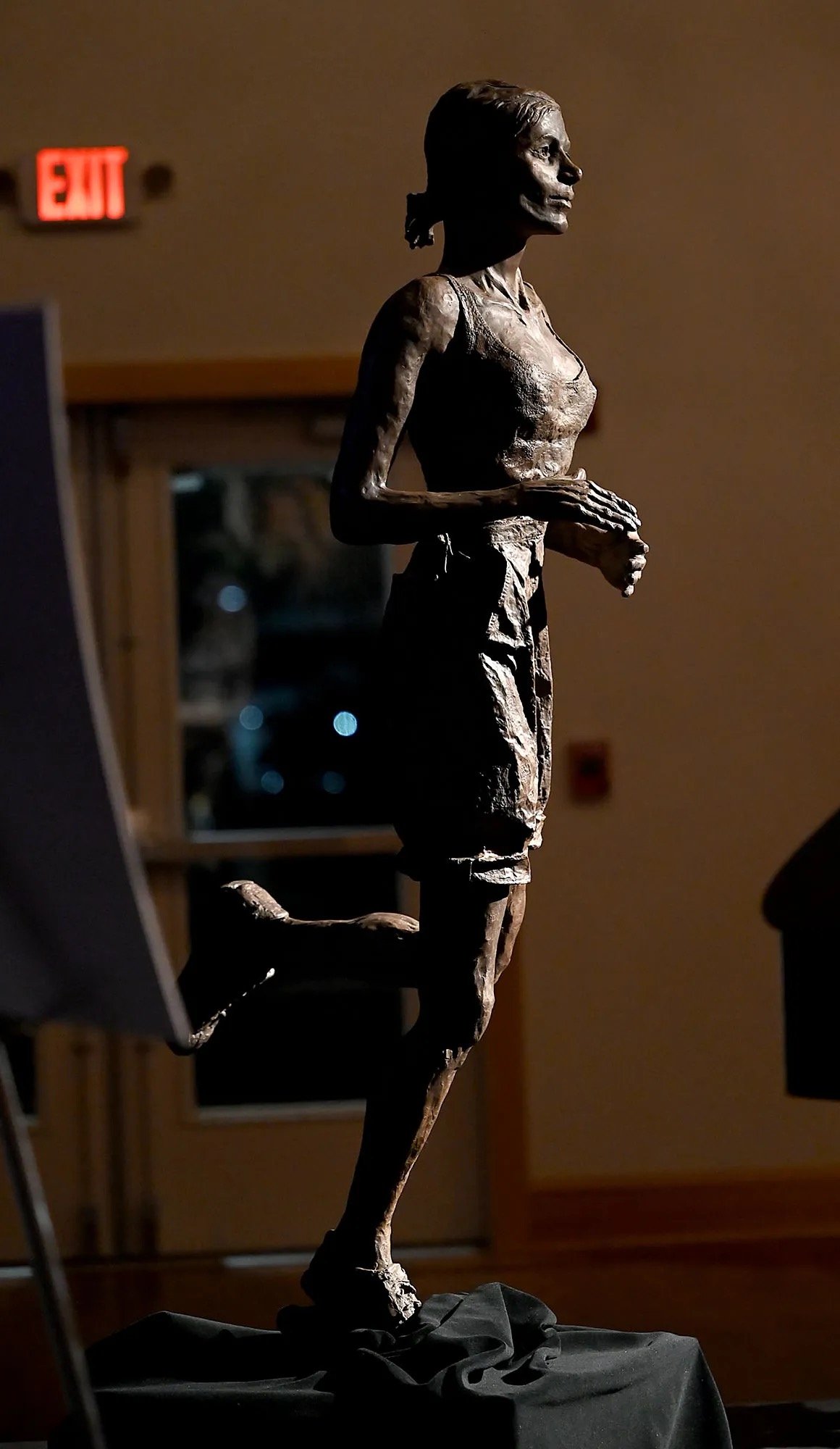
Gibb's statue, The Girl Who Ran, now located near the Boston Marathon start line, depicts Gibb running the Boston Marathon in 1966. It is a symbol of the power of ordinary people to change the world for the better. Gibb is both the subject and the sculptor. Image credit: Ken McGagh.
Gibb's magic has always been in how she sees the world: She sees the magical and extraordinary in the mundane. In her teens and early twenties, she felt freer, more herself and more at home running through the woods with a pack of neighborhood dogs than anywhere else in the world. When she saw the Boston Marathon for the first time in 1964, she fell in love with it, unaware that women were prohibited from running more than a mile and a half competitively.
For the next two years, she trained in secret as her life took many twists and turns through love, adventure and danger. As part of her training, she set off on a 3,000-mile solo journey west in a VW bus with her wolflike malamute dog. Every day, she ran for miles in a new place; at night, she slept out under the stars. She nearly lost her life. On a mountaintop a hundred miles from anywhere, she looked up into a luminous night sky and experienced the universe as the ultimate miracle, brimming with life and love. Here in the universe, she felt free and at home in a way she had never felt before.
She ran 65 miles of a three-day horseback riding event in the mountains of Vermont and countless miles over chaparral, sagebrush and sparkling beaches in California. Now incredibly strong and fast and able to run 40 miles at a stretch, Gibb wrote to the Boston Marathon organizers requesting a number. She was shocked to receive a curt letter back stating that women were not physiologically able to run 26.2 miles and were therefore barred from entering the race.
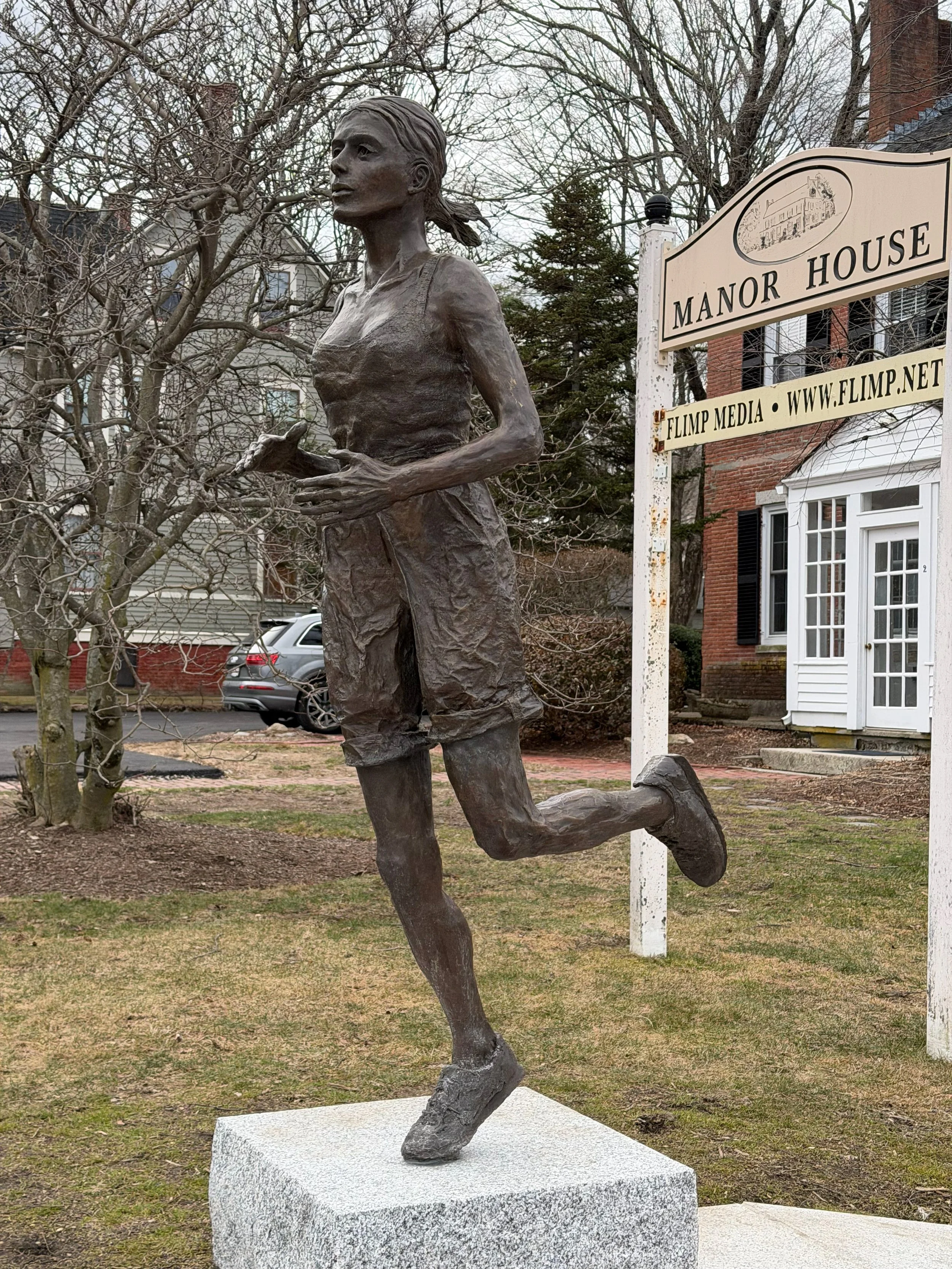
Gibb's statue was installed near the Boston Marathon start line on March 27, 2026.
She realized that if she could prove this false belief about women wrong, she could throw into question all the other false beliefs about women that had been used to deny women opportunities for centuries. She defiantly ran and completed the Boston Marathon, staying true to herself despite the rules, false beliefs about women and all the setbacks she had experienced. She finished ahead of two-thirds of the men, and news of her stunning achievement went out in headlines around the world: a woman had done the impossible and run the Boston Marathon.
In the words of one 1966 spectator, Diana Chapman Walsh, who later became President of Wellesley College, "That was my senior year at Wellesley. As I had done every spring since I arrived on campus, I went out to cheer the runners. But there was something different about that Marathon Day—like a spark down a wire, the word spread to all of us lining the route that a woman was running the course. For a while, the "screech tunnel" fell silent. We scanned face after face in breathless anticipation until just ahead of her, through the excited crowd, a ripple of recognition shot through the lines and we cheered as we never had before. We let out a roar that day, sensing that this woman had done more than just break the gender barrier in a famous race…"
Gibb’s triumphant, barrier-breaking run was a pivotal event in history: Although she is the only woman in the world known to have run any marathon during the year 1966, there has never been a year since then when women haven't run marathons. She returned in 1967 (finishing about an hour ahead of Kathrine Switzer) and in 1968 (finishing first among four women). We now know that a few women around the world had run 26.2 miles in the years before 1966, and they had been largely ignored. Inspired by Gibb, and through the efforts of the courageous women and men who followed, such as Nina Kuscsik, women ran the Boston Marathon officially for the first time in 1972. In 1984, Gibb sculpted the three bronze sculpture trophies for the first U.S. Women's Olympic Marathon Trials. In 1996, the Boston Marathon organizers recognized Gibb as the first woman to run the Boston Marathon and the women's winner in 1966, 1967 and 1968, awarded her a medal, and inscribed her name three times with the names of the other winners on the Boston Marathon Memorial in Copley Square, Boston. In 2016, the women's winner, Atsede Baysa of Ethiopia, gifted her trophy to Gibb, who returned it to Baysa the following year.
Gibb has been described as a renaissance woman: runner, artist, neurodegenerative disease researcher, lawyer, and philosopher. She has self-published several books. Gibb's creative and unconventional spirit led to her breakthrough in 1966. Her statue near the Boston Marathon start line will remind future generations that through boldness, love and creativity, we can overcome our fears and change the world for the better.
May 2026
Copyright © 2020-2026 Bobbi Gibb
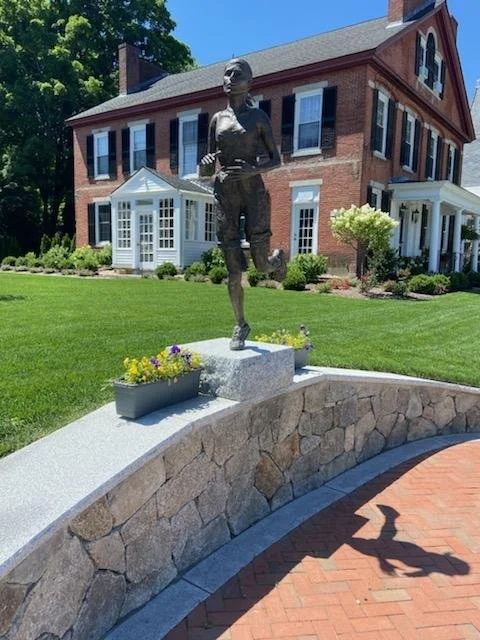
Gibb’s The Girl Who Ran statue, July 2026. Image credit: 26.2 Foundation.